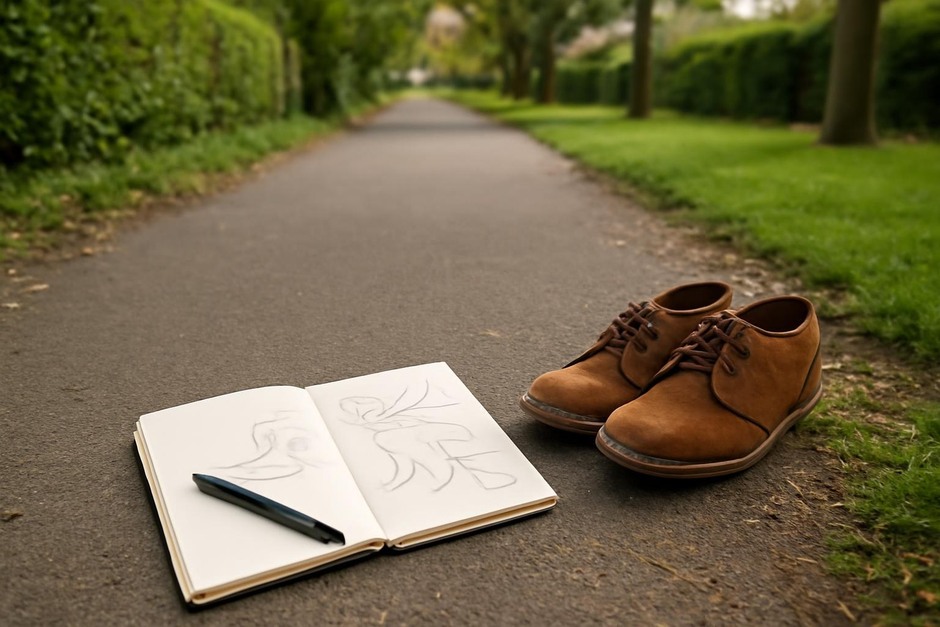
Studio Notes: Mapping a Familiar Path by Sound, Smell, and Texture
Opening observation: I pass the same stretch of pavement every morning and, until recently, could have described it only by houses and a familiar maple. One day I decided to ask a different question: what if I mapped this place by what I hear, what I smell, and what I can feel under my hands and feet? The small experiment that followed felt like studio work—one clear question, a few modest tools, and an attentive process.
The Question: Narrow the focus
Start with one precise question. Mine was: “How does this route present itself through sound, scent, and texture between 7:30 and 8:00 a.m.?” A narrow question keeps the walk practical. You might choose a different hour, a route of four blocks, or one sensory channel—scent only, for example. Note your constraints: weather, time, and whether you want quiet observation or gentle note-taking while walking.
Process — Listening Walk (sound)
Method: Walk the route once without writing, just listening. Then walk a second time with a pocket notebook or a short voice note for three distinct moments: beginning, middle, end. For each moment, jot three labels—foreground sounds, midground, and background. Example labels: “squeak of swing (foreground), distant traffic hum (midground), woodpecker taps (background).”
Studio note: keep categories loose. Foreground might be human voices or very near mechanical sounds; background could be wind through leaves or distant highway. Time of day changes the balance. The act of labeling forces distinction: what feels dominant here? What recedes when a car passes?
Process — Smell and Air (olfactory mapping)
Method: Pause at three points and take a slow, deliberate breath or two through the nose. Let the first clear exhale pass, then inhale and name what you notice. Common descriptors: damp earth, cut grass, baking bread, diesel, floral, compost, frying oil. If nothing distinctive appears, note the absence—”neutral cool air” is a useful datum.
Studio note: smells are tied to activities and places. A bakery’s odor anchors a corner differently than a line of evergreen trees. Write short composite labels rather than precise chemical names: they help you remember scenes later without striving for exhaustive vocabulary.
Process — Touch and Surface (texture, temperature, and detail)
Method: Bring touch into the map. Put your hand on three surfaces if it’s safe: a fence post, a brick wall, a park bench. Note temperature, grain, and any small features (moss, flaking paint, metal burr). Also pay attention to underfoot: gravel crunch, smooth pavement, muddy patch. Describe these in tactile terms: coarse, slick, springy, cold.
Studio note: texture anchors memory differently than sight. A cold, iron gate will recall a corner of the route more reliably than the color of a house. If touching is not appropriate, use the soles of your shoes: does the route feel springy, uneven, or worn smooth? Include a quick sketch or rub in your notebook if you like—a single line drawing can capture more than words.
Measured conclusion: review and gentle edits
After the walks, sit for five minutes with your notes and ask three review questions: what repeated elements emerged across senses; which observation surprised me; what adjustments would improve the next session? In my walk the recurring motif was rhythm—an alternating pattern of distant traffic and intermittent bird calls. The surprise was how often bakery and frying oil traded places depending on wind direction. An adjustment: next time try the same route at a different hour to compare the sensory balance.
Studio note: the goal is not comprehensive inventory but a tighter, sensory-informed map of a familiar place. Your notes become a layered sketch: sound punctuates smell, texture anchors the scene, and together they make the route legible in a new way.
Putting it to use and a modest next step
Keep one small outcome in mind. You might label a simple map with three icons—an ear for the loudest sound, a nose for the strongest scent, and a hand for the most memorable texture. Carry that map on your next walk and see whether the markers hold or shift. Over weeks, these small adjustments form a record of how a place changes without needing elaborate equipment.
Final thought: treating a routine walk as studio work reframes ordinary places as active subjects. The question-and-process approach keeps the exercise manageable and repeatable. The review closes the loop, turning curiosity into subtle knowledge of a place you already thought you knew.